
Or Ronai
I am an MSc candidate in the Electrical and Computer Engineering faculty at the Technion, under the supervission of Prof. Tomer Michaeli.
I received my BSc (Summa Cum Laude) in Electrical and Computer Engineering at the Technion as well.
My research interests lie in the fields of deep learning, computer vision, generative models and signal processing.
Contact me at or dot ronai at campus dot technion dot ac dot il.
Publications
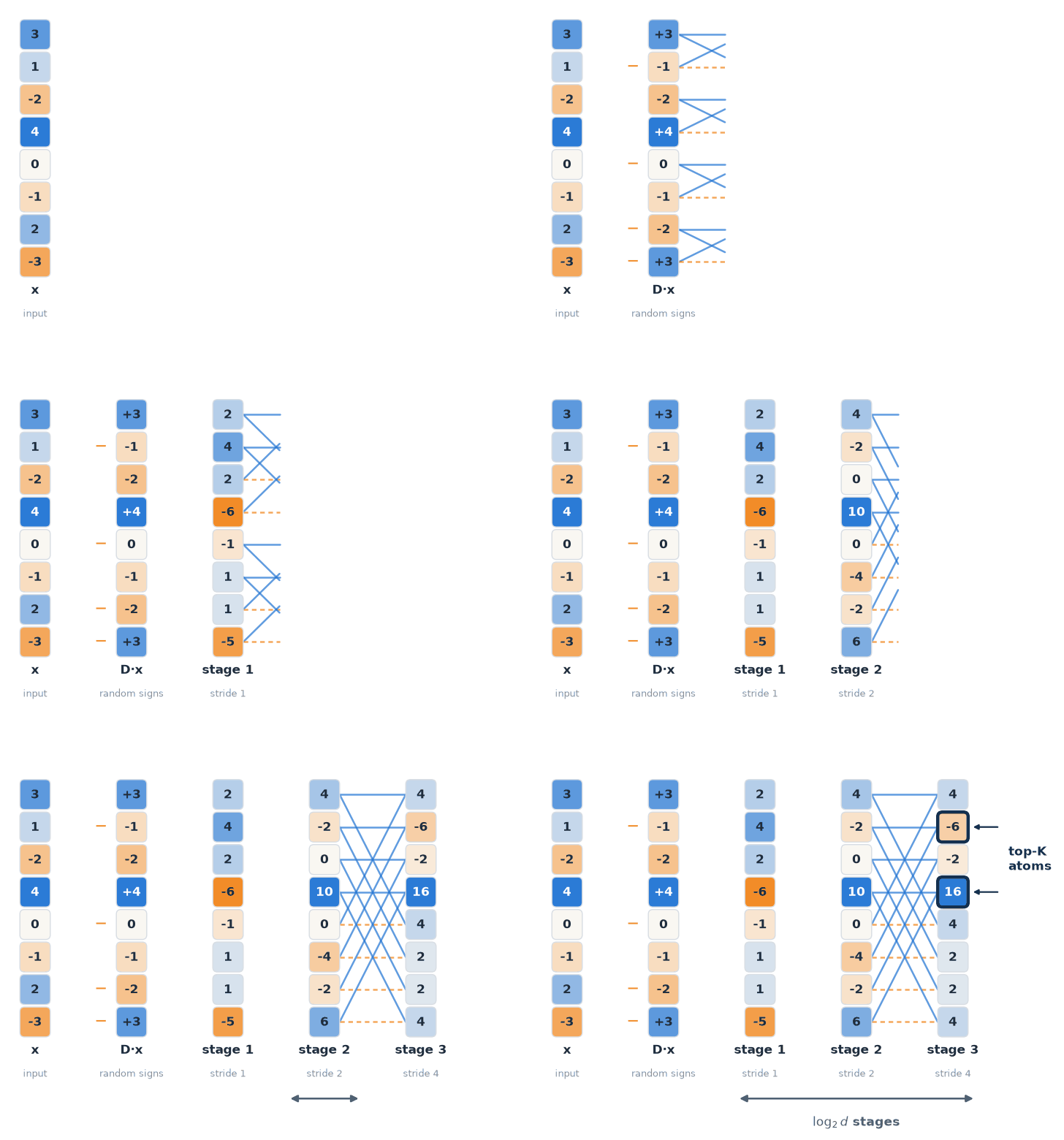
H-DDCM: Hadamard Codebooks for Fast Generative Image and Video Compression
Or Ronai*,
Vladimir Kulikov*,
Tomer Michaeli
H-DDCM replaces dense Gaussian codebooks with implicit randomized Hadamard dictionaries, computed on the fly with the fast Walsh–Hadamard transform in O(d log d) time and O(d) memory. This makes training-free generative compression fast and memory-light for images, and close to real-time for long videos on a single GPU.
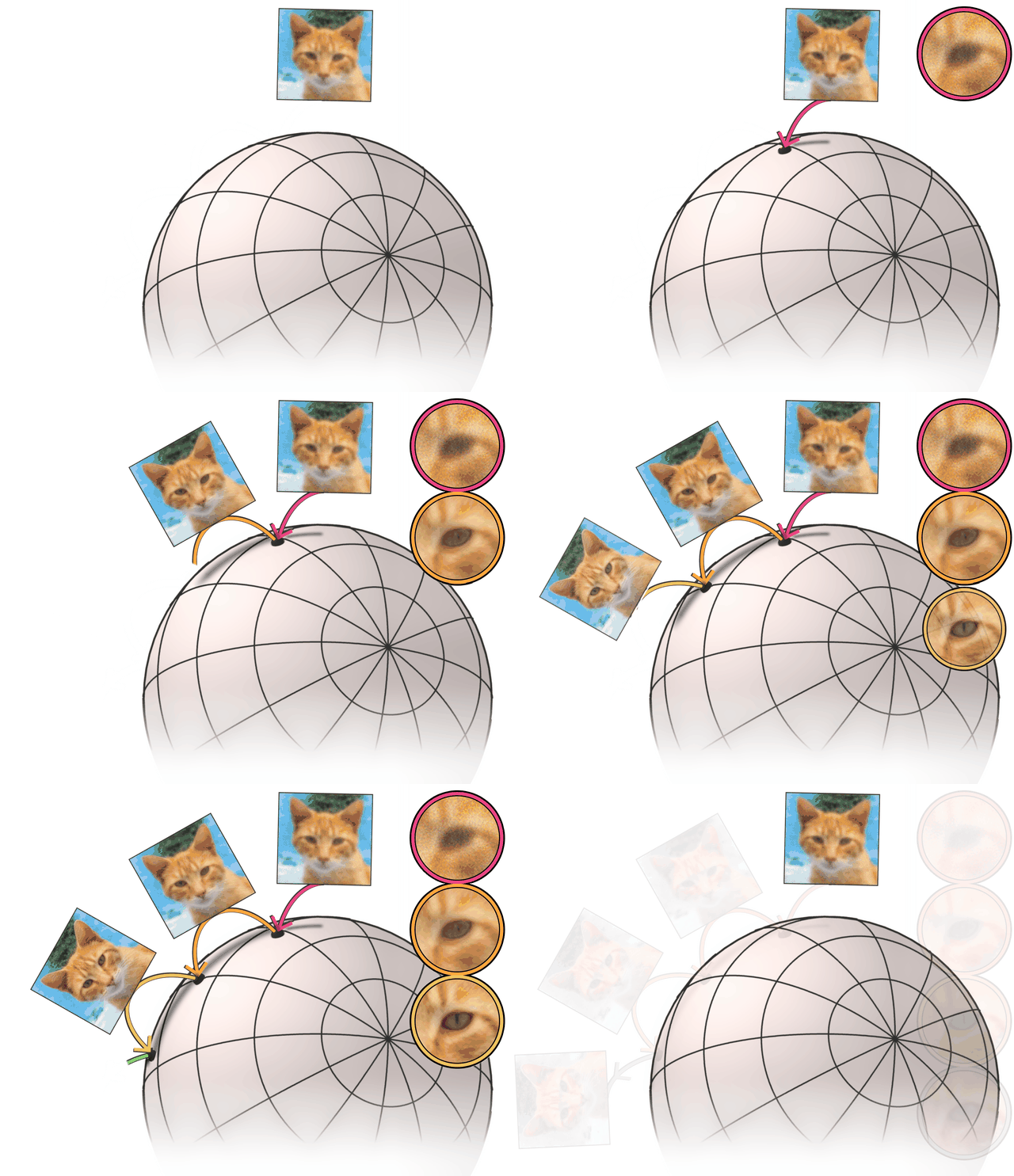
SP3: Spherical Priors for Plug-and-Play Restoration
Sean Man,
Ron Raphaeli,
Matan Kleiner,
Or Ronai
SP3 is plug-and-play restoration with Spherical Encoders as generative priors, enabling stable “anytime” results with perceptual quality comparable to zero-shot diffusion and flow methods while running 3–630× faster.
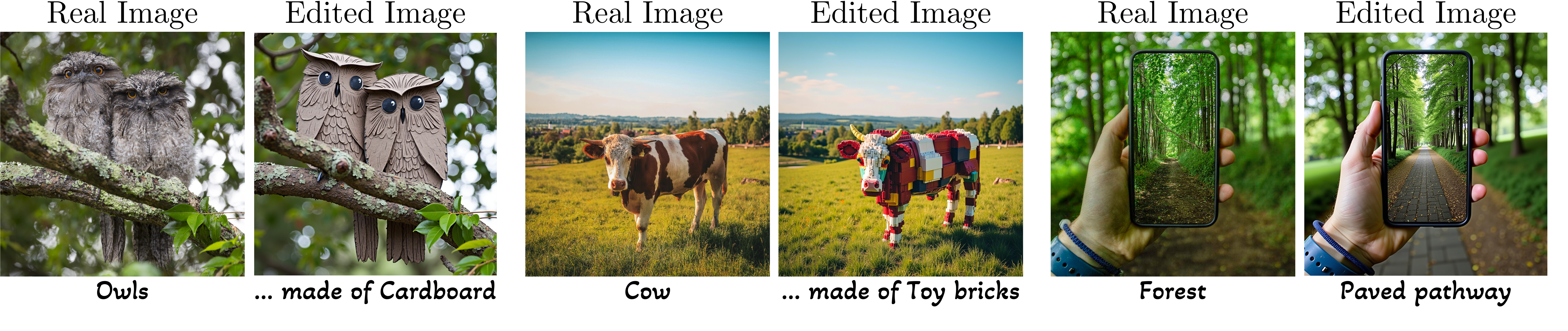
FlowOpt: Fast Optimization Through Whole Flow Processes for Training-Free Editing
Or Ronai,
Vladimir Kulikov,
Tomer Michaeli
FlowOpt is a gradient-free optimization framework that treats the whole flow sampling path as a black box, with a provable step-size condition for convergence. It achieves state-of-the-art training-free image editing at roughly the same number of function evaluations as existing methods.

Subspace Method for RTF Estimation and Speech Enhancement Using Riemannian Geometry
Or Ronai,
Amitay Bar,
Ronen Talmon,
Israel Cohen
A new RTF estimator that combines the sample correlation matrix with the Riemannian mean of correlation matrices, followed by subspace filtering. Plugged into an MVDR beamformer, it improves speech enhancement in noisy, reverberant scenes with multiple interferers.

RTF Estimation Using Riemannian Geometry for Speech Enhancement in the Presence of Interferences
Or Ronai*,
Yuval Sitton*,
Amitay Bar,
Ronen Talmon
The Riemannian mean of short-time spatial correlation matrices keeps the desired source’s shared spatial structure while suppressing intermittent interference, giving more accurate RTF estimates and better MVDR speech enhancement than Euclidean estimation.
 ?
?
Adapted from the personal webpages of Hila Manor and Matan Kleiner, 2024 | Icons from Icons8, Font Awesome & Academicons
Parts of this webpage were based on Tim O’Brien's t413.com — SinglePaged theme.